How AI in Supercomputing is Powering the Next Digital Revolution

The speed of technology is increasing. Better machines, smarter apps, and faster decision-making are all being introduced every day. The combination of artificial intelligence (AI) and supercomputing is one of the most significant changes occurring behind the scenes.
How AI in supercomputing is driving the next digital revolution
This paper looks at how Artificial Intelligence (AI) is changing the field of supercomputing and how this combination is leading to the next digital revolution. It looks at how these two powerful technologies are coming together and what AI-enhanced supercomputing could mean for the future in a number of fields. This document shows how AI is unlocking new supercomputing capabilities that can speed up scientific discovery and improve complicated systems. These new capabilities are opening the door to innovative new technologies and answers to some of the world's most pressing problems.
The Coming Together of AI and Supercomputing
AI algorithms are now being added to supercomputers, which have always been known for their capacity to do complicated computations very quickly. This coming together is making a new way of thinking about computational science and engineering. AI systems, especially those that use machine learning and deep learning, can look at huge amounts of data, find patterns, and make very accurate predictions. AI may speed up scientific discovery, make complicated systems work better, and make new applications conceivable that were not possible before when used with the raw processing capacity of supercomputers.
Important Uses of AI in Supercomputing
Finding out new things in science
AI is changing the way scientists do their work by letting them look at huge datasets and find patterns that would be hard to find by hand. For instance, in genomics, AI algorithms may look at huge volumes of genetic data to find genes linked to certain diseases. This can lead to novel ways to diagnose and treat certain diseases. AI can forecast the qualities of novel materials in materials science, which speeds up the search for materials with the right properties. AI can look at astronomical data in astrophysics to find new celestial objects and events.
Modeling the Climate
Climate models are very complicated and need a lot of computing power to replicate the Earth's climate system. AI can make climate models more accurate and efficient by looking at past data and finding patterns that can be utilized to make predictions more accurate. AI can help us better plan for and respond to catastrophic weather disasters like hurricanes and floods by making predictions about them more accurately.
Finding New Drugs
Finding new medications takes a lot of effort and money. AI can speed up the process of finding new drugs by finding possible drug candidates, estimating how well they will work and how harmful they will be, and improving their design. AI may be used to search through huge collections of chemical compounds to find the ones that are most likely to bind to a certain target protein. This can help produce novel treatments for diseases like cancer and Alzheimer's.
Making Models of Money
Financial markets are complicated and always changing, so you need advanced models to guess how they will act and keep your money safe. AI can make financial models more accurate and useful by looking at past data and finding patterns that can be used to guess what will happen in the market. AI can, for instance, find fake transactions, improve investment portfolios, and keep an eye on risk in real time.
Design for Engineering
AI can make the designs of complicated technical systems, like airplanes, cars, and buildings, better. AI can find designs that are more efficient, dependable, and cost-effective by looking at a lot of data and trying out many design possibilities. For instance, AI can be used to improve an airplane's aerodynamics, which lowers drag and makes the plane use less fuel.

Advantages of supercomputing with AI
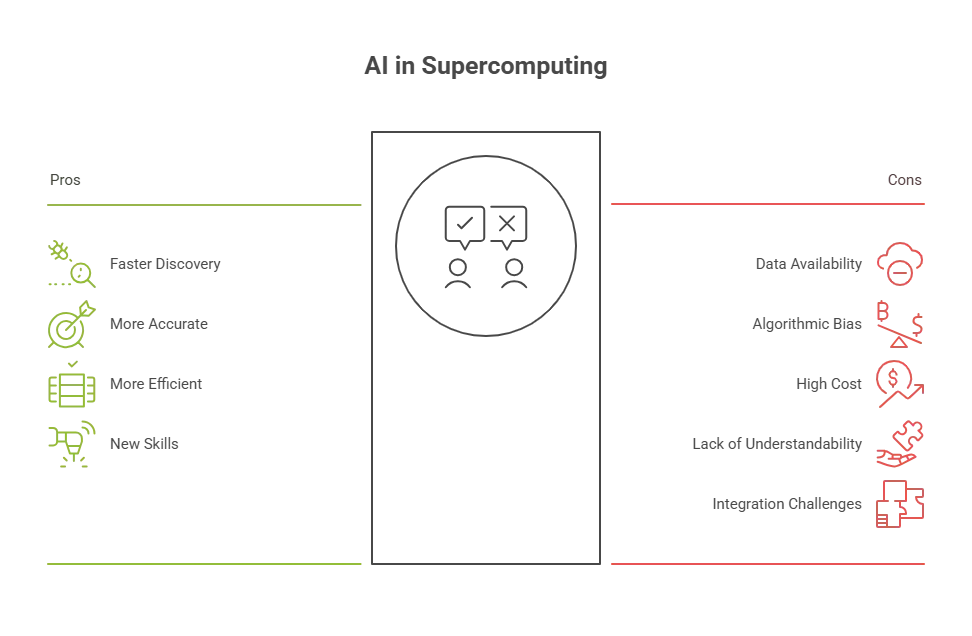
Faster Discovery
AI can speed up scientific discovery by letting researchers look at huge datasets and find patterns that would be impossible to find by hand. This could lead to big advances in areas like climate science, materials science, and medicine.
More Accurate
AI can make simulations and forecasts more accurate by using past data to find patterns that can be exploited to make models work better. This can help people make better choices in areas like engineering, finance, and climate science.
More efficiency
AI can make complicated systems work better by improving their design and operation. This can save money, make things work better, and have less of an effect on the environment.
New Skills
AI can make things possible that were not conceivable before, such detecting fraud in real time, tailored treatment, and self-driving cars.
Problems and Where to Go Next
Data Availability
To work well, AI systems need a lot of data to learn from. In some areas, it may be hard to find or get to data. To get the most out of AI in supercomputing, we need to solve problems with data availability.
Algorithmic Bias
If the data used to train AI systems is biased, the algorithms can be prejudiced too. This can cause results that are not fair or correct. It is crucial to carefully look at the data used to train AI algorithms and come up with ways to reduce bias.
The cost of computation
It can take a lot of resources to train and use AI algorithms, which might be quite expensive. The cost of computing will keep going up as AI algorithms get more complicated. To make AI more accessible, we need to make AI algorithms and technology that work better.
Understandability
It can be hard to understand some AI systems, such deep neural networks. This can make it hard to figure out why an AI algorithm chose to do anything. Building trust and making sure people are responsible are both significant reasons to make AI systems easier to understand.
Putting things together
It can be hard to add AI algorithms to current supercomputing procedures. It is necessary to build tools and methods that make it easier to add AI to supercomputing settings.
The Future of AI in Supercomputing
The future of AI in supercomputing seems good. AI will be used in increasingly more breakthrough ways in sectors like medicine, materials research, climate science, and engineering as AI algorithms get better and supercomputers get stronger. AI will become more and more crucial in finding solutions to some of the world's most urgent problems, such as finding new ways to treat diseases and slowing down climate change. The next digital revolution is coming, and it will change the way we live, work, and interact with the world around us. This is because AI and supercomputing are coming together.