AI Transformation 2025: Shaping the Future of Business and Leadership

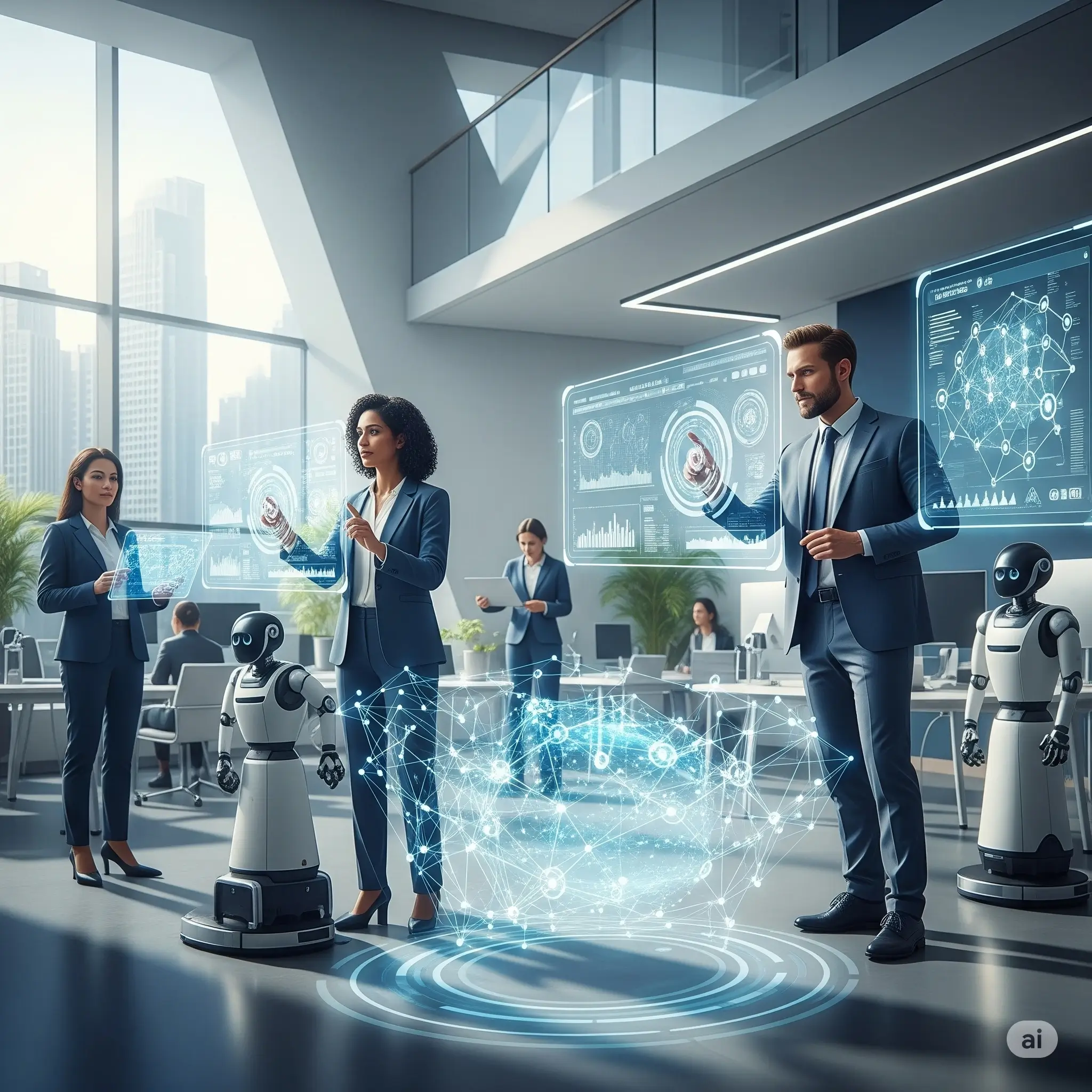
Have you ever noticed how your executive team reacts when the subject of implementing AI is brought up? Half fear, half excitement, and complete unsure of where to start. By 2025, let's get past the hype surrounding AI and talk about what's truly happening.
While their rivals waste time in planning paralysis, forward-thinking leaders are already implementing the AI transformation roadmap that this guide explains. As AI capabilities move from experimental to indispensable, the business environment is changing beneath our feet.
What keeps me up at night, though, is the growing divide between businesses that are embracing AI strategically and those that are still considering it a side project. What distinguishes these two methods? Which companies make it through the next three years may depend on it.
This essay looks at how artificial intelligence (AI) is likely to change business and leadership by the year 2025. It looks at key areas that are changing, like how workers interact with each other, how customers feel, how well the company runs, and how decisions are made. It also talks about the abilities you need to do well in the future workplace and how leadership will change as we adapt to this AI-driven world.
A Look at the Future: The State of AI in 2025
By 2025, AI will be a big part of practically every part of how businesses work. There will probably be changes in a lot of critical areas:
More Automation: AI-driven quality control will make sure that products are of the highest quality; intelligent document processing (IDP) will find insights in unstructured data; robotic process automation (RPA) will handle workflows from start to finish; and AI-powered automation will go beyond simple tasks to include more complex ones.
Hyper-Personalization: AI will let businesses give their customers experiences that are very unique to them. This includes proactive customer support, dynamic pricing, marketing campaigns that are tailored to each customer's requirements and wants, and product suggestions that are unique to each consumer.
Predictive Analytics: AI will give businesses advanced abilities to make predictions. This means figuring out how many customers will leave, what the market will do, how to make supply chains more efficient, and how to find prospective risks and chances.
AI-Augmented Decision-Making: AI will be a powerful tool to help people make decisions. This means giving advice based on data, modeling different situations, and recommending the best course of action.
Changing the way businesses work
AI will change how businesses work in several ways, such as:
Supply Chain Management: AI will make supply chains better by predicting demand, managing inventory levels, and making logistics easier. Costs will go reduced, and things will work better and be more resilient as a result.
Manufacturing: AI will drive automation in manufacturing, which will lead to better production scheduling, quality assurance, and predictive maintenance. As a result, product quality will go up, productivity will go up, and downtime will go down.
Finance: AI will take care of financial reporting, risk management, and finding fraud. This will make people more likely to follow the rules, cut costs, and make things more accurate.
Human Resources: AI will change how HR works by automating hiring processes, tailoring training for each employee, and getting employees more involved. This will lead to a more productive and efficient group of workers.
Sales and Marketing: AI will help you design ads that are more relevant to your audience, find better prices, and make more accurate sales forecasts. As a result, revenue will go up and getting new customers will be easier.

Making the Client Experience Better
AI will be very important for making the client experience better:
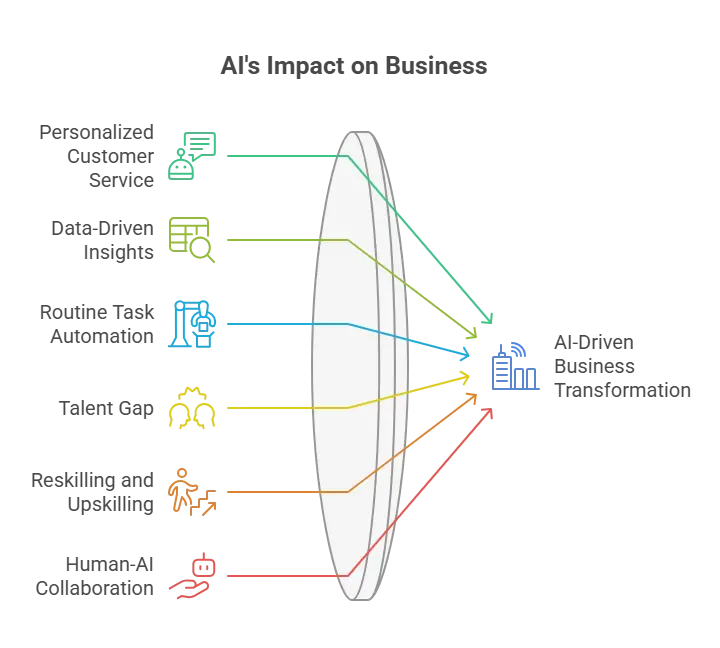
Personalized Customer Service: AI-powered chatbots and virtual assistants will provide immediate, personalized customer service by answering inquiries and fixing problems.
AI will let businesses communicate with customers in a proactive way that meets their specific needs and wants, predicting problems and fixing them right away.
AI will aggregate customer interactions across several channels to give them a smooth and consistent experience, no matter how they want to contact with the organization.
Data-Driven Insights: AI will look at consumer data to uncover trends and patterns that can help us understand what they like and how they act. This will help businesses better tailor their products and services to meet the needs of their customers.
The Changing Workforce: AI will change the workforce in a dramatic way, delivering both good and bad things.
Routine Task Automation: AI will take care of a lot of boring and repetitive jobs, freeing up human workers to focus on more creative and strategic work.
AI will make new occupations that require skills in areas like AI development, AI ethics, and data science.
Talents Gap: Because there is a greater demand for AI-related talents than there are people with those skills, businesses will need to start training and developing their employees.
Reskilling and Upskilling: Businesses will need to invest in reskilling and upskilling their workers so that they are ready for the changing needs of the AI-driven economy.
Working Together: In the future, people and AI will work together intimately. People will use AI to improve their talents and get more done.
What Leaders Do in the Age of AI
Strong leadership will be needed to get through the AI transformation:
Vision and Strategy: Leaders need to have a clear vision and strategy on how to use AI to reach business goals.
Change Management: Leaders need to handle the change that comes with the use of AI well so that the transition goes smoothly and employees' concerns are heard.
Ethical difficulties: To make sure that AI is used in a way that is both smart and moral, leaders need to deal with the moral difficulties that come up with the technology.
Talent development: Leaders need to put money into talent development to make sure that employees have the skills and knowledge they need to do well in the AI-driven economy.
Leaders need to create a data-driven culture in order to get employees to use data to make smart choices.
Important Skills for Leaders in 2025
To do well in an AI-driven world, leaders will need to learn a new set of skills:
Strategic thinking is the ability to plan ahead and come up with a unique vision for the future.
Data literacy is the ability to understand, evaluate, and use data to make smart choices.
Adaptability means being able to accept new technology and change.
Cooperation means being able to get along with people, even AI systems.
Emotional intelligence is the ability to understand and manage your own feelings and make strong connections with other people.
Ethical Awareness: A full understanding of the moral questions that come up with AI.
Constant Learning: a commitment to learning and growing for the rest of your life.

Conclusion
AI Transformation 2025 gives businesses and their leaders both big chances and big problems. By using AI, businesses may get ahead of their competitors, make customers happier, and run their operations more smoothly. Still, it is important to deal with the moral issues that come up with AI and to put money into training and retraining workers. Leaders who learn the skills they need for the AI era will be able to lead their organizations through this revolutionary moment with ease. AI will be very important for business and leadership in the future, and the people who understand this will be the most successful.